At some point, most manufacturers and OEM buyers face the same decision. Do you build fabrication capability in-house, or do you hand it off to a dedicated partner? Both paths can work. But they carry very different costs, risks, and long-term implications.
This isn’t a decision to make on gut feeling. It comes down to volume, part complexity, capital budget, and how central fabrication is to your core product. Below is a straight comparison of both paths, so you can weigh the real trade-offs before committing either way.
What “In-House Fabrication” Actually Requires
Building fabrication capability internally sounds simple on paper. Buy the equipment, hire the people, start producing parts. In practice, it means taking on several layers of cost and complexity most buyers underestimate upfront.
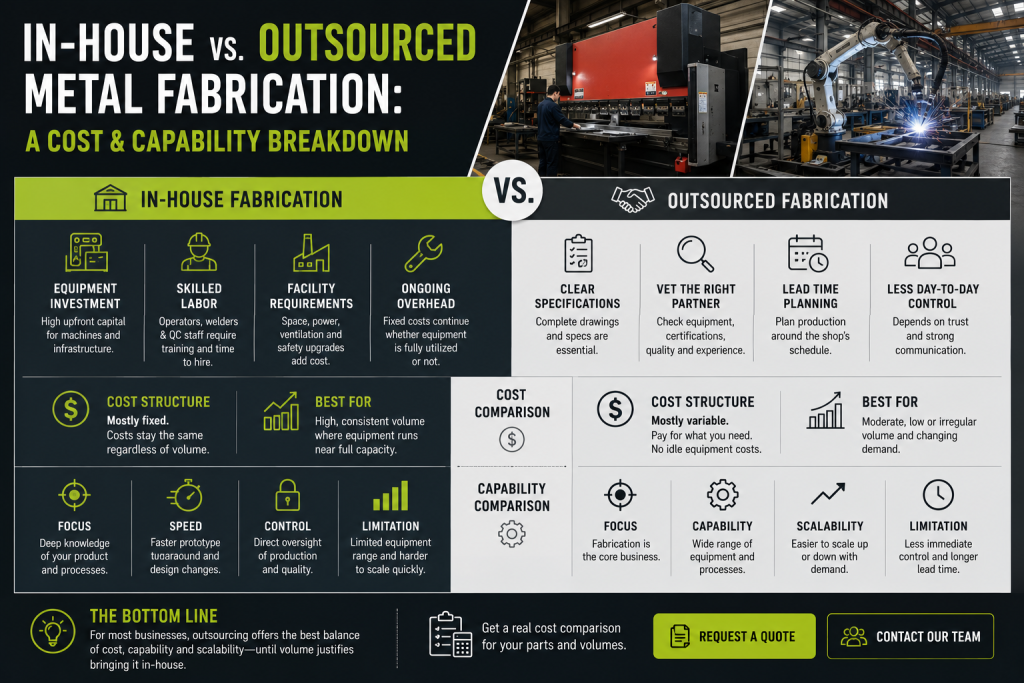
Equipment investment. A single laser cutter can run into six figures. Add a CNC press brake, welding stations, and finishing equipment, and the capital outlay climbs fast. Most of this equipment also depreciates over time and needs regular maintenance to hold its precision.
Skilled labor. Machine operators, welders, and quality control staff all need specific training. Skilled welders in particular are in short supply in many markets, which drives up wages and makes hiring slower than expected.
Facility requirements. Fabrication equipment needs space, ventilation, power capacity, and safety infrastructure. Retrofitting an existing facility to support this often costs more than buyers plan for.
Ongoing overhead. Beyond the initial setup, in-house fabrication means carrying fixed costs every month, whether you’re running at full capacity or not. Equipment sits idle during slow periods, but the lease payments and maintenance contracts don’t pause with it.
What Outsourcing Actually Requires
Outsourcing shifts most of that complexity onto a fabrication partner. But it comes with its own set of requirements and trade-offs.
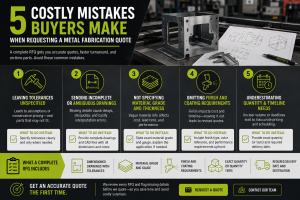
A clear specification process. Since you’re not standing next to the machine, your drawings, tolerances, and material specs need to be complete and accurate. A strong RFQ process becomes the mechanism that replaces on-the-floor oversight.
Vetting the right partner. Not every fabricator handles every material, process, or volume well. Choosing a partner means checking their equipment list, certifications, quality control process, and track record on similar parts.
Lead time planning. Unlike an in-house line you control directly, outsourced production runs on a shared shop floor with other customers’ orders. Lead times need to be built into your own project planning rather than assumed to be instant.
Less day-to-day control. You won’t be able to walk over and check on a part mid-production. This trade-off is real, and it’s one reason communication and trust with a fabrication partner matter as much as their equipment does.
Cost Comparison: Where the Numbers Actually Land
In-house costs are mostly fixed. Equipment, facility, and core staff costs stay roughly the same whether you’re producing 10 parts or 10,000 in a given month. That fixed cost only pays off once volume is high and consistent enough to keep the equipment running near capacity.
Outsourced costs are mostly variable. You pay per part or per production run, and that cost scales directly with what you actually order. There’s no idle equipment to carry through a slow quarter, and no capital tied up in machinery that depreciates whether it’s used or not.
The break-even point depends on volume. For low to moderate, irregular volume, outsourcing is almost always cheaper once you account for the full cost of equipment, labor, and overhead. For very high, consistent volume over a long time horizon, in-house production can eventually become cheaper per unit. Where that break-even point sits depends heavily on your specific parts, equipment costs, and labor market, so it’s worth running the numbers for your actual situation rather than assuming either answer by default.
Hidden costs cut both ways. In-house fabrication carries hidden costs in downtime, scrap, and the learning curve as staff ramp up on new equipment. Outsourcing carries hidden costs in lead time buffers and the coordination overhead of managing an external partner. Neither path is free of costs beyond the obvious line items.
Capability Comparison: What Each Path Can Actually Deliver
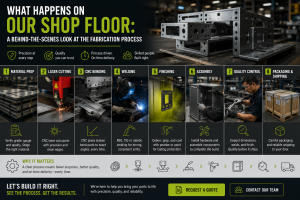
Equipment breadth. A dedicated fabrication partner typically invests in a wider range of equipment than any single manufacturer would justify for its own product line. That means access to laser cutting, CNC bending, robotic welding, and finishing capabilities without having to fund each one separately.
Process expertise. A fabrication shop’s core business is fabrication. Its staff spend every day refining cut quality, weld consistency, and finish standards across many different customers and parts. An in-house team, by contrast, is usually focused on your specific product, which builds deep familiarity with your parts but less breadth of general fabrication expertise.
Scalability. Outsourcing makes it far easier to scale production up or down with demand, since you’re not constrained by your own equipment capacity or headcount. In-house capacity is fixed until you invest in more of it, which makes it harder to respond quickly to a demand spike.
Speed of iteration. In-house fabrication can offer faster turnaround on design changes and prototypes, since there’s no external RFQ and scheduling cycle to go through. This is one of the strongest arguments for keeping fabrication in-house when a product is still in active development and design changes are frequent.
When In-House Fabrication Makes Sense
- Fabrication is core to your product, not a supporting process, and tight integration with design and engineering delivers a real competitive advantage.
- Volume is high and consistent enough to keep equipment running near capacity most of the time.
- Your team is iterating on designs frequently and needs same-day turnaround on prototypes.
- You have the capital available to invest in equipment without straining cash flow elsewhere in the business.
When Outsourcing Makes Sense
- Volume is moderate, low, or irregular, and doesn’t justify the fixed cost of owning equipment.
- You need access to processes or equipment beyond what makes sense to buy for your own product line.
- Capital is better spent on core product development than on fabrication infrastructure.
- You’re entering a new product category and don’t yet know what your long-term fabrication needs will look like.
Making the Call
For most OEM buyers and manufacturers outside of heavy, high-volume production, outsourcing tends to offer the better cost and capability balance, at least until volume reaches a scale that justifies the fixed investment. The clearest way to test that assumption for your own business is to price out both paths against your actual parts, volumes, and timeline, rather than relying on a general rule of thumb.
Get a Real Cost Comparison for Your Parts
At Wintech, we work with OEM buyers and manufacturers who are actively weighing this decision. We can quote your actual parts and volumes, so you’re comparing outsourcing against a real number instead of a guess.
Ready to submit an RFQ that gets you a fast, accurate quote? Request a Quote or Contact Our Team to talk through your project specs.