Category: OEM Manufacturing Solutions

  • How to Choose a Metal Fabrication Partner: An OEM Buyer’s Guide
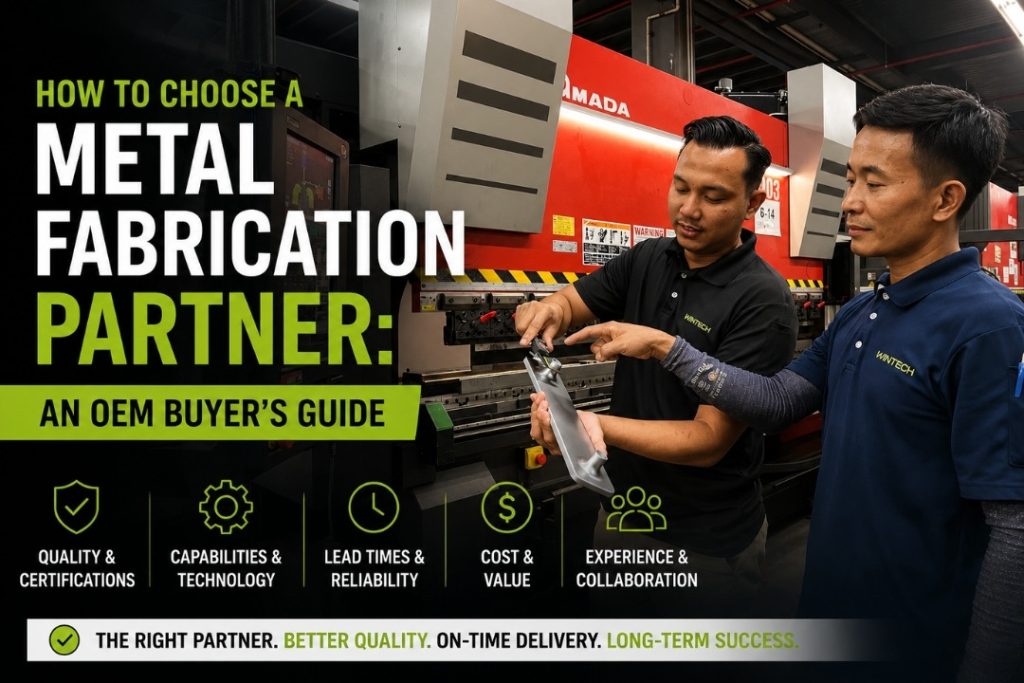
    How to Choose a Metal Fabrication Partner: An OEM Buyer’s Guide

    Choosing the wrong metal fabrication supplier doesn’t just cost you money. It costs you time, program schedules, and sometimes your own customer relationships. For OEMs, a fabrication partner isn’t a line item, it’s an extension of your engineering and production team. Get it wrong, and you’re managing missed deadlines, inconsistent tolerances, and quality escapes. Get it right, and you gain a partner who helps you design smarter, launch faster, and scale without drama.

    This guide breaks down the criteria that actually matter when evaluating a metal fabrication partner and the red flags that should make you keep looking.

    Why the Right Fabrication Partner Matters More Than Price

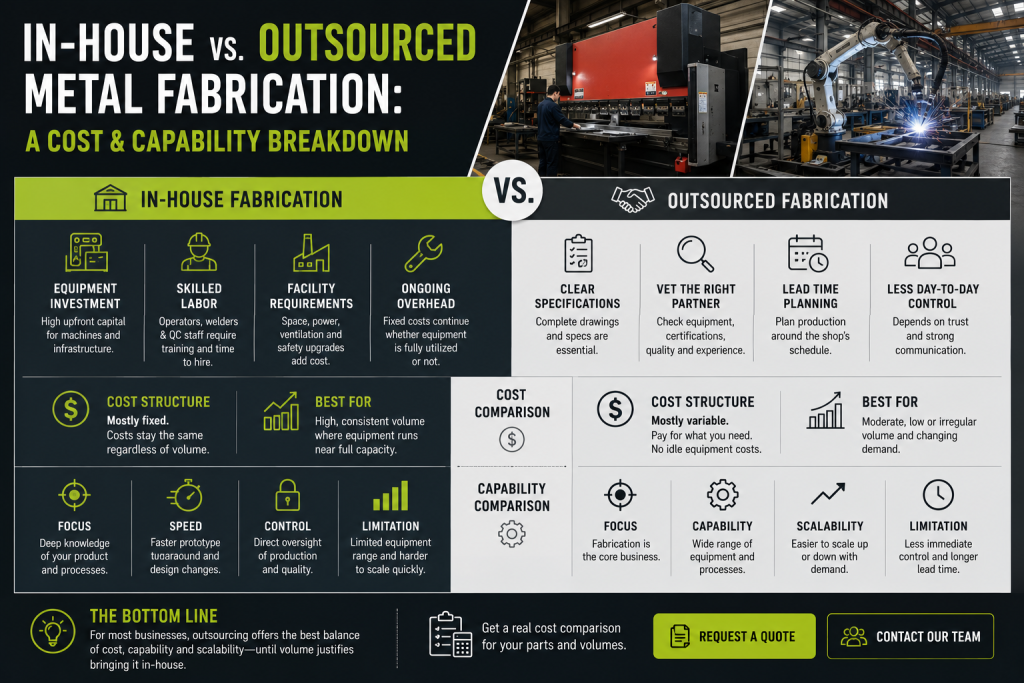
    It’s tempting to make sourcing decisions on quoted price alone. But the total cost of a fabrication relationship includes far more than the per-part number:

    • Rework and scrap from inconsistent tolerances
    • Expedite fees when a supplier can’t hit committed lead times
    • Engineering hours spent chasing down design-for-manufacturability issues that should have been caught upfront
    • Program risk if a supplier can’t scale with your volume

    A partner with slightly higher unit pricing but tighter process control, better communication, and reliable delivery will almost always cost less over the life of a program. The goal isn’t the cheapest quote — it’s the lowest total cost of ownership.

    1. Manufacturing Capabilities That Match Your Part Mix

    Not every fabricator does everything well. Before you even request a quote, map your part portfolio against a supplier’s core capabilities:

    • Sheet metal cutting (laser, plasma, waterjet)
    • CNC punching and forming
    • Press brake bending
    • Welding (MIG, TIG, robotic)
    • Machining for secondary operations
    • Finishing (powder coat, plating, anodizing)
    • Assembly and light kitting

    A shop that’s excellent at high-volume laser cutting may not be the right fit for low-volume, high-complexity welded assemblies. Ask directly: what percentage of your current work looks like my parts? A supplier whose typical job resembles yours will have already solved the problems you’re about to run into.

    2. Quality Systems and Certifications

    Certifications aren’t just a checkbox — they’re a proxy for whether a shop has documented, repeatable processes.

    At minimum, look for:

    • ISO 9001 — baseline quality management system
    • Industry-specific certifications where relevant (AS9100 for aerospace, IATF 16949 for automotive, ISO 13485 for medical)

    But certification alone isn’t proof of quality. Ask to see their process for handling non-conformances. A supplier who can walk you through a real corrective action report (with root cause analysis, not just “we retrained the operator”) is showing you a mature quality culture.

    3. Tolerance Capability and Honesty About It

    Every fabricator will tell you they can hold tight tolerances. Fewer will tell you what it costs to actually hold them consistently, in production, at volume, not just on a single prototype part.

    When evaluating tolerance capability:

    • Ask for their standard tolerance chart by process (cutting, forming, welding)
    • Ask what tolerances require special tooling or secondary operations
    • Request sample parts or case studies with dimensional reports, not just marketing claims

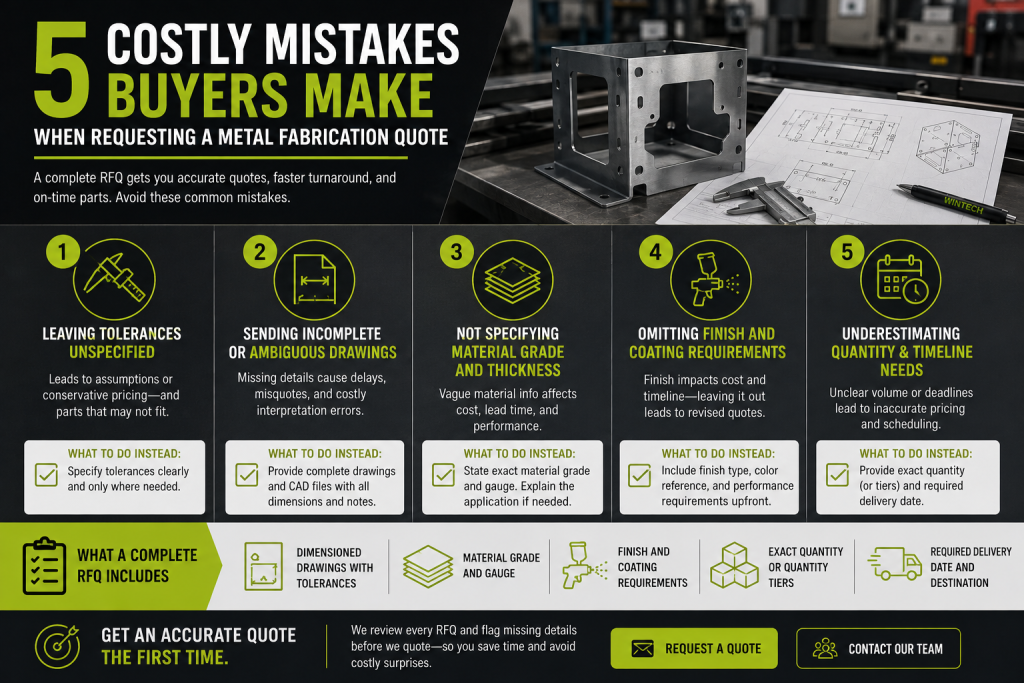
    A trustworthy partner will tell you when your drawing calls for tolerances tighter than the process needs and suggest where you can open up tolerances without affecting function, saving you cost. That kind of design-for-manufacturability feedback is a strong signal of a true engineering partner rather than a job-shop vendor.

    4. Capacity and Scalability

    Your fabrication partner needs to handle where your program is today and where it’s going in 12-24 months. Ask about:

    • Current utilization rates (a shop running at 95% capacity has little room for your growth or urgent orders)
    • Equipment redundancy (what happens if their one CNC laser goes down?)
    • Multi-shift operations and overtime flexibility
    • Raw material sourcing relationships and lead times

    Scalability cuts both ways, you also want a supplier that’s not so large that a mid-volume OEM program gets deprioritized behind bigger accounts.

    5. Lead Time Reliability, Not Just Speed

    A quoted lead time only matters if it’s consistently met. Ask potential partners for their on-time delivery rate over the past 12 months, and ask how they define “on time”, some suppliers measure against ship date, others against original promise date, which can hide a lot of expediting and rescheduling.

    Also probe:

    • How they communicate when a delay is likely, and how early
    • Whether they hold safety stock or raw material on your behalf for repeat programs
    • Their process for expediting without compromising quality

    6. Engineering and Design Support

    The best fabrication partners get involved before the drawing is finalized. Look for suppliers who offer:

    • Design-for-manufacturability (DFM) reviews
    • Material substitution recommendations
    • Prototype-to-production transition support
    • CAD/CAM collaboration during quoting

    This kind of upfront collaboration catches costly design issues — bend relief problems, weld access issues, tolerance stack-up — before they become expensive change orders mid-program.

    7. Communication and Program Management

    Especially for multi-part assemblies or ongoing production programs, ask who your day-to-day point of contact will be, and how issues get escalated. Fragmented communication where every question requires three emails and a phone call, is a leading indicator of future program headaches.

    Good signs:

    • A named program manager or dedicated account contact
    • Proactive status updates rather than reactive ones
    • Clear escalation paths for quality or schedule issues

    8. Financial Stability and Longevity

    A fabrication partner going out of business mid-program is one of the most disruptive events an OEM can face. While you can’t fully audit a supplier’s financials, you can look for indirect signals:

    • Years in business and ownership stability
    • Investment in new equipment (a sign of reinvestment and confidence)
    • Customer references you can actually call, particularly in your industry

    Red Flags to Watch For

    • Vague answers about certifications or quality processes
    • Reluctance to provide references or sample dimensional reports
    • Pricing significantly below the rest of the field with no clear explanation
    • No dedicated point of contact for your program
    • Pushback on design-for-manufacturability conversations

    Building a Long-Term Fabrication Partnership

    The strongest OEM-fabricator relationships aren’t transactional, they’re collaborative. The right partner should feel less like a vendor you manage and more like an extension of your engineering team, one that flags problems early, suggests improvements, and scales alongside your business.

    If you’re evaluating fabrication partners for an upcoming program, it’s worth requesting a facility tour or virtual walkthrough, reviewing a few real (not cherry-picked) quality records, and starting with a smaller trial run before committing volume. The upfront diligence is far cheaper than the cost of switching suppliers mid-program.

    Looking for a metal fabrication partner who treats your program like their own? Contact us to discuss your part requirements and see how our engineering and quality teams support OEM programs from prototype through full production.

  • OEM Metal Fabrication Services: End-to-End Precision Manufacturing for Global Industries
    OEM Metal Fabrication Services: End-to-End Precision Manufacturing for Global Industries

    End-to-End Metal Fabrication Capabilities

    We deliver complete OEM metal fabrication solutions, combining advanced technology, skilled workmanship, and stringent quality control to support high-performance applications across global industries.

    Our integrated capabilities cover the full production cycle:

    1. Uncoiling and Shearing

    Efficient processing of metal coils into precise sheet sizes, ensuring consistency for downstream fabrication.

    2. Laser Cutting

    High-precision laser cutting technology enables complex geometries, tight tolerances, and clean edges across a wide range of materials.

    3. Punching

    Accurate and repeatable punching processes designed for high-volume production with consistent quality.

    4. Bending

    Advanced press brake systems shape metal into precise forms required for structural and functional applications.

    5. Stamping

    High-speed stamping solutions for mass production of durable components with uniform specifications.

    6. Welding

    Robust welding capabilities, including MIG and TIG processes, ensuring strong and reliable assemblies.

    7. Surface Finishing

    Comprehensive finishing processes to enhance corrosion resistance, durability, and product appearance.


    Supporting Industries Worldwide

    We provide OEM metal fabrication solutions tailored to the needs of diverse industries across global markets:

    Commercial Building & Facilities

    Structural components, enclosures, and fabricated systems supporting building infrastructure and operations.

    Industrial Manufacturing & Semiconductor

    Precision components engineered for high-performance manufacturing environments requiring accuracy and reliability.

    OEM & Equipment Manufacturers

    End-to-end fabrication support from prototype development to large-scale production of equipment components.

    Workspaces & Home Applications

    Custom metal fabrication for furniture structures, workspace solutions, and modern living environments.

    Healthcare & Education

    Durable and high-quality fabrication for environments requiring safety, hygiene, and long-term reliability.


    Why Work With Us

    Integrated Manufacturing

    Our end-to-end fabrication capabilities streamline production, reduce lead times, and improve supply chain efficiency.

    Precision Engineering

    We ensure tight tolerances and consistent quality using advanced fabrication technologies and controlled processes.

    Scalable Production

    Flexible manufacturing capacity supports both low-volume prototypes and high-volume production runs.

    Quality Assurance

    Stringent quality control is applied throughout every stage of production to meet international standards and specifications.


    A Reliable Partner for OEM Manufacturing

    OEM metal fabrication is a critical component of your supply chain. Choosing the right partner ensures consistent product quality, operational efficiency, and long-term reliability.

    We support global customers with:

    • Consistent and repeatable manufacturing quality
    • Efficient production timelines
    • Technical expertise across fabrication processes
    • Reliable delivery for international projects

    Contact Us for OEM Metal Fabrication Enquiries

    For OEM metal fabrication requirements or project discussions, please contact our team:

    📧 enquiries@wintech.com.my

    We will respond promptly to understand your specifications and provide the most suitable fabrication solutions.