A request for quote is supposed to be the fast part. You send over what you need. A fabricator prices it. You decide whether to move forward. In practice, a lot of RFQs turn into a slow back-and-forth of clarifying questions, revised quotes, and pushed-back timelines. The reason is almost always the same: the original request didn’t give the fabricator enough information to price it accurately the first time.
Most buyers don’t make these mistakes on purpose. They usually just don’t know what a fabricator needs to see. But the mistakes still cost money and time. They lead to inflated quotes that build in risk buffers, timelines that stretch out over rounds of clarification, and in the worst cases, parts that come back wrong because a detail got assumed instead of specified. Here are the five mistakes that show up most often, and what to do instead.
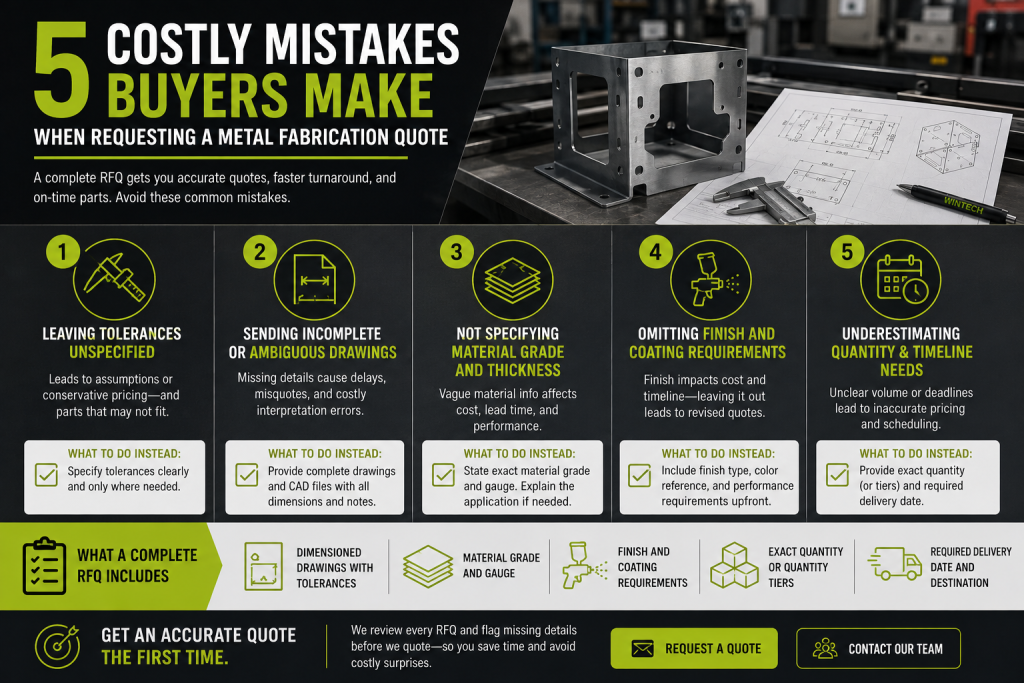
Mistake 1: Leaving Tolerances Unspecified
This is probably the single most common gap in an RFQ. A drawing shows the dimensions a part needs to be, but it doesn’t say how much variation is acceptable. Without that information, a fabricator has two options. They can assume a standard tolerance, or they can quote conservatively to cover the risk that the part actually needs a tighter spec.
Both options cost the buyer something. An assumed standard tolerance might not be tight enough for the part to function correctly, and that usually doesn’t surface until the parts arrive. A conservative quote often costs more than necessary, since tighter tolerances take more time and more careful process control to hit consistently.
What to do instead: State the tolerance requirement directly on the drawing. Only specify tight tolerances where the part actually needs them. Not every dimension needs the same precision, and calling out which features are critical helps a fabricator price the job accurately instead of treating the whole part as high-precision by default.
Mistake 2: Sending Incomplete or Ambiguous Drawings
A quick sketch, a photo of a napkin drawing, or a CAD file missing critical dimensions can get you a rough ballpark number. It can’t get you an accurate quote. When a fabricator has to guess at a dimension, infer a bend direction, or assume a hole is centered rather than offset, that guess becomes a source of risk. It shows up in the price, the timeline, or both.
This mistake is especially costly because it often stays invisible until parts are already in production. A dimension that looked clear enough on the drawing gets interpreted one way by the fabricator and a different way by the buyer. Nobody catches the mismatch until the finished part doesn’t fit where it’s supposed to.
What to do instead: Provide a complete drawing with all dimensions, material thickness, bend directions, and hole locations clearly called out. If you have a CAD file, include it alongside a PDF. Native files let a fabricator’s team review the actual geometry instead of working from a flattened image. If a formal drawing isn’t ready yet, say so upfront and expect a preliminary estimate rather than a firm quote.
Mistake 3: Not Specifying Material Grade and Thickness
“Steel” isn’t a material specification. It’s a category. Mild steel, stainless steel, and aluminum fabricate differently, cost differently, and behave differently once installed. Grade and gauge matter too, even within one category. A part specified as “3mm steel” without a grade forces the fabricator to assume a common one. That assumption may not match what the application actually needs, especially where corrosion resistance, weldability, or structural load are on the line.
This mistake also affects lead time directly. A material the fabricator already stocks can move straight into production. A specific grade or gauge that needs to be special-ordered adds procurement time that won’t show up anywhere in the RFQ itself.
What to do instead: Specify the exact material grade and gauge. If there’s a reason behind that choice, corrosion resistance, weight, cost, weldability, mention it. If you’re not sure what material fits the application, say that too. A good fabrication partner can recommend a grade based on how the part will be used, but only if they know what that use case actually is.
Mistake 4: Omitting Finish and Coating Requirements
Finish is easy to forget. It feels like a downstream detail, something to sort out after the part itself is settled. But finish requirements affect both price and timeline, and they’re hard to add back in once a quote has already gone out. Powder coating, plating, and painting are typically separate process stages with their own setup, and powder coating adds curing time on top of that. A custom color match takes longer than a standard stock color. A specialty coating for outdoor or high-corrosion environments costs more than a standard finish.
Leaving finish out of the initial RFQ almost guarantees a revised quote once the requirement surfaces later. By then, the buyer has already lost the time it took to get the first quote.
What to do instead: Include finish type, color (with a reference standard like RAL or Pantone if precision matters), and any performance requirements like UV resistance or salt-spray rating, right in the original RFQ. If finish hasn’t been decided yet, ask for pricing both with and without it so the decision doesn’t stall the rest of the process.
Mistake 5: Underestimating the Value of Exact Quantity and Timeline Needs
“We’ll probably need around 50, maybe more later” is a common way to phrase a quantity. It’s also a hard number for a fabricator to quote against. Pricing per unit changes with volume, since setup costs spread across more parts at higher quantities. A vague quantity forces a fabricator to either guess at a single volume or provide a range of prices across several possible quantities. Either way, it takes longer to prepare and makes the quote harder to compare against others.
The same problem applies to timeline. A buyer who needs parts in three weeks and a buyer who needs parts in three months should expect different pricing and different production scheduling. But a fabricator can only plan around that if the deadline is stated upfront, not after the quote comes back.
What to do instead: Give a firm quantity if you have one, or a small number of specific quantity tiers if volume is still being decided (for example, pricing at 50, 100, and 250 units). State the required delivery date directly, even if it’s flexible, so the fabricator can flag early whether it’s realistic.
What a Complete RFQ Actually Looks Like
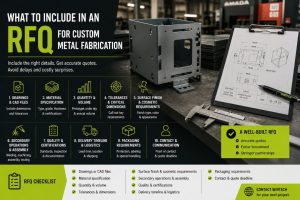
Put all five fixes together, and a strong RFQ includes:
- Complete, dimensioned drawings with tolerances called out
- Material grade and gauge
- Finish and coating requirements, including color standard if applicable
- Exact quantity, or specific quantity tiers
- Required delivery date and destination
None of this takes specialized knowledge to put together. It just takes treating the RFQ as the moment where the real specification gets communicated, not a placeholder to fill in later through back-and-forth emails. A complete RFQ almost always gets a faster, more accurate, and more competitive quote than a partial one, because the fabricator isn’t pricing in the risk of the unknown.
Get an Accurate Quote the First Time
At Wintech, we review every RFQ against exactly this checklist, and we’ll flag anything missing before we quote, not after production starts. That means fewer revisions, faster turnaround, and a price that reflects your actual part, not a worst-case assumption.
Ready to submit an RFQ that gets you a fast, accurate quote? Request a Quote or Contact Our Team to talk through your project specs.