A weak RFQ almost guarantees a frustrating quoting process. Vague specs lead to mismatched bids that can’t be compared apples to apples, missing details lead to follow-up emails that stretch a two-week quote turnaround into a month, and unclear expectations lead to a final price that doesn’t match what actually shows up on the shop floor.
A well-built RFQ does the opposite. It lets suppliers quote quickly and accurately, it lets you compare bids on equal footing, and it sets the tone for a partner relationship built on clear communication from the very first interaction. This guide walks through exactly what to include.
Why RFQ Quality Determines Quote Quality
Fabricators quote based on the information in front of them. If your RFQ leaves out a critical detail, one of two things happens: the supplier makes an assumption (which may not match what you actually need), or they come back with questions (which slows down your timeline). Either way, an incomplete RFQ costs you time, and often costs you money if assumptions turn out wrong once production starts.
The goal of a strong RFQ isn’t just getting a number back quickly. It’s getting an accurate number, one that won’t change once the supplier actually sees the real requirements.
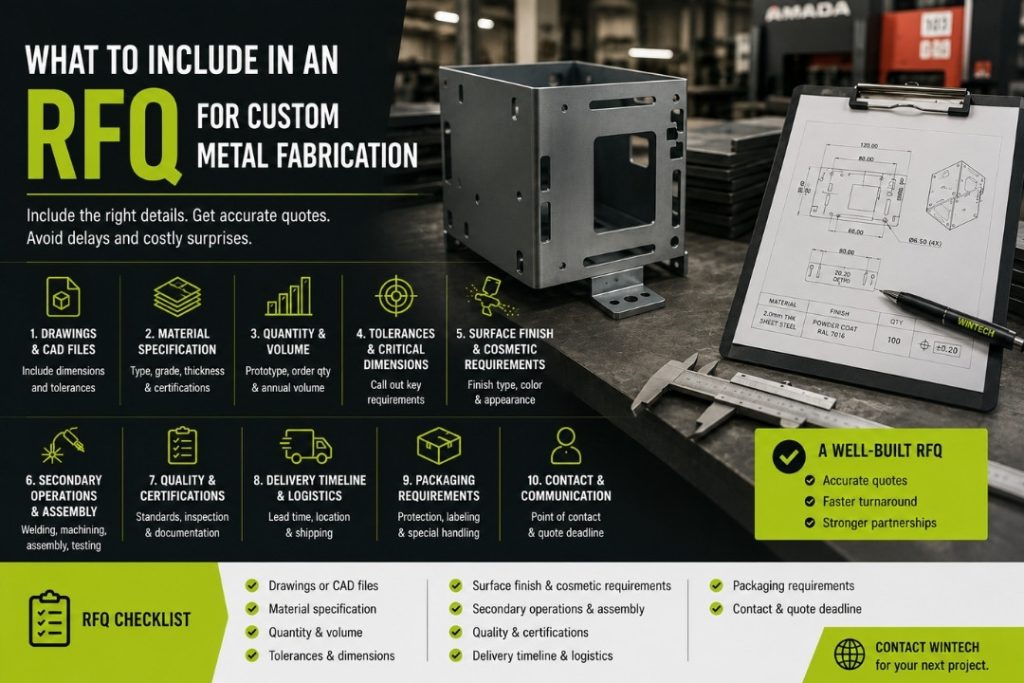
1. Complete Technical Drawings or CAD Files
This is the foundation of any RFQ. At minimum, include:
- 2D drawings with fully dimensioned views, including tolerances
- 3D CAD models (STEP, IGES, or native format) where available, since these speed up quoting and reduce interpretation errors
- Clear callouts for critical dimensions, GD&T requirements, and any features that require special attention
If drawings are still in development, say so. A supplier can often still provide a rough budgetary quote, but flag it clearly as preliminary so there’s no confusion later about why the final quote differs.
2. Material Specification
Be specific. “Steel” isn’t enough information to quote accurately. Include:
- Material type and grade (such as A36 mild steel, 304 stainless, 5052 aluminum)
- Gauge or thickness
- Any required material certifications (mill certs, material traceability requirements)
- Approved substitutions, if any, in case your primary specification has long lead times or supply constraints
Material cost and availability can swing quotes significantly, so precision here directly affects how comparable your bids will be.
3. Quantity and Volume Expectations
Quantity affects pricing more than almost any other RFQ variable, since it determines whether tooling costs, setup time, and batch efficiencies come into play. Include:
- Prototype or first article quantity, if applicable
- Initial production order quantity
- Annual or projected volume, even if it’s an estimate
If you expect the program to scale over time, say so. Suppliers price differently for a one-time order of 50 units versus an initial order of 50 units that’s expected to grow to 5,000 annually, and knowing your growth trajectory helps them quote tooling and capacity decisions appropriately.
4. Tolerances and Critical Dimensions
Beyond what’s already noted on the drawing, call out which tolerances are truly critical to function versus which are standard shop tolerances. This helps suppliers understand where they need to invest in tighter process control (which affects cost) and where standard capability is sufficient.
Being explicit here also invites useful pushback. A supplier who understands your functional requirements can flag if a tolerance is tighter than necessary, potentially saving you cost without affecting the part’s performance.
5. Surface Finish and Cosmetic Requirements
Specify:
- Required finish type (powder coat, plating, anodizing, mill finish, and so on)
- Color or finish specification (RAL codes, Pantone references, or physical samples if color matching matters)
- Cosmetic acceptance criteria, particularly for visible or consumer-facing parts
- Any masking or selective finishing requirements
Finishing is often quoted as a separate line item, and unclear finish requirements are one of the most common sources of post-quote clarification requests.
6. Secondary Operations and Assembly Requirements
If your parts require more than cutting and forming, spell it out:
- Welding requirements, including joint type and any applicable welding codes or certifications needed
- Machining operations beyond the primary fabrication process
- Assembly instructions, including hardware, fasteners, or sub-component integration
- Any testing or functional verification required before shipment
Leaving secondary operations vague is one of the fastest ways to end up with quotes that aren’t actually comparable, since one supplier may have assumed a scope the others didn’t.
7. Quality and Certification Requirements
Different industries carry different baseline expectations. Include:
- Required certifications (ISO 9001, AS9100, IATF 16949, ISO 13485, and so on)
- Inspection and documentation requirements (dimensional reports, certificates of conformance, material certs, PPAP, first article inspection)
- Any industry-specific compliance requirements (RoHS, REACH, or similar)
If your industry doesn’t require formal certifications but you have internal quality expectations, state them anyway. A supplier’s quote should reflect the actual quality process your program requires, not a generic baseline.
8. Delivery Timeline and Logistics
Include:
- Required lead time for prototypes or first articles
- Required lead time for production quantities
- Delivery location and any special packaging or shipping requirements
- Whether you need staggered deliveries, blanket orders, or just-in-time delivery scheduling
If your timeline is firm (tied to a product launch or a customer commitment, for example), say so directly. Suppliers can often accommodate tight timelines with the right advance notice, but only if they know about the constraint upfront.
9. Packaging Requirements
Packaging is easy to overlook but can meaningfully affect both cost and part condition on arrival. Note any requirements around:
- Protective packaging for cosmetic or precision parts
- Palletization or crating standards
- Labeling requirements
- Any customer-specific packaging specifications you need to pass through
10. Point of Contact and Communication Expectations
Include who suppliers should direct questions to, and by when you need the quote returned. If you’re running a formal bid process with a set deadline, state it clearly, along with how you’d like questions handled (a single point of contact, a Q&A document, and so on) to keep the process fair and efficient across all bidders.
RFQ Checklist Summary
Before sending your RFQ, confirm it includes:
- Complete drawings or CAD files, with clear tolerance callouts
- Full material specification, including grade and certification requirements
- Quantity for prototypes, initial orders, and projected annual volume
- Critical tolerances flagged separately from standard tolerances
- Finish and cosmetic requirements, including color specification
- All secondary operations: welding, machining, assembly, testing
- Required quality certifications and documentation
- Delivery timeline and location
- Packaging requirements
- Point of contact and quote deadline
A Better RFQ Leads to a Better Partner Relationship
A thorough RFQ does more than get you a fast, accurate quote. It signals to potential suppliers that you run a well-organized program, which tends to attract more serious, detailed responses in return. It also gives you a much stronger basis for comparing bids, since suppliers quoting against identical, complete information are far easier to evaluate side by side than suppliers each filling in their own assumptions.
If you’re not sure whether your RFQ has everything a supplier needs, a good fabrication partner will tell you what’s missing rather than just quoting around the gaps. That responsiveness, even before you’ve placed an order, is often a useful early signal of how the relationship will work once you do.
Have a project ready to quote? Contact us with your drawings and specifications, and our team will follow up with any clarifying questions before returning an accurate, detailed quote.