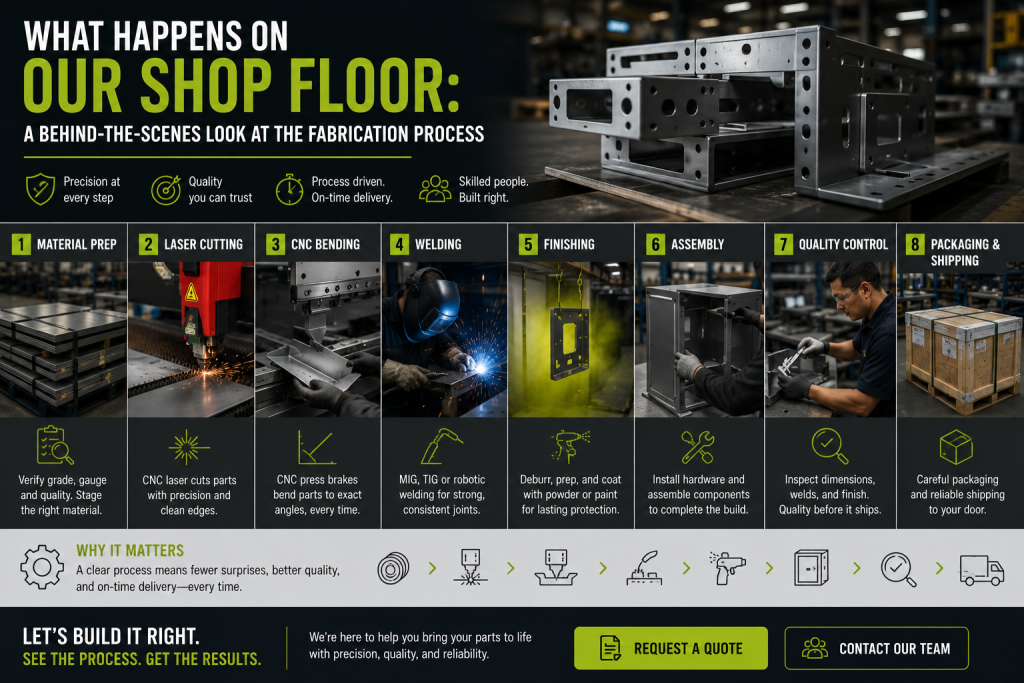
Most buyers see two things clearly: the quote they approve and the finished part that arrives. Everything in between happens on the shop floor, out of view. That middle stretch is where the actual work gets done. Understanding it helps buyers ask better questions, spec parts more accurately, and know what to expect at each stage.
Here’s what actually happens between an approved RFQ and a finished, shipped part.
Station 1: Material Prep
Before anything gets cut, the team pulls, checks, and stages raw material. A sheet of steel, aluminum, or stainless doesn’t just come off the rack ready to go. The team verifies the grade and gauge against the job spec. They check for surface defects or damage from storage. Then they stage the correct sheets at the cutting station.
This step matters more than it looks. A mismatched grade or gauge caught here costs minutes. The same mistake caught after cutting or bending costs an entire part, and sometimes an entire batch.
Station 2: Laser Cutting
This is where a flat sheet becomes a shaped part. A laser cutter follows a programmed path, guided by the part’s CAD file, and cuts through the material with a focused beam. The process handles complex geometries, tight-radius corners, and precise hole placement. Mechanical cutting methods would be far slower and less consistent for the same work.
Operators monitor the cut for edge quality and dimensional accuracy as parts come off the machine. Even a well-programmed cut can drift if the material has inconsistencies, so this station isn’t fully hands-off.
Station 3: CNC Bending
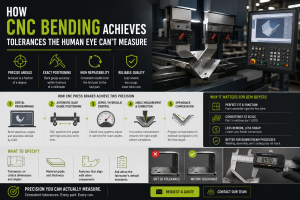
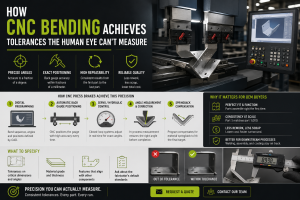
Flat, cut parts move to the press brake for forming. A CNC-controlled machine folds the material along programmed lines. It hits specific bend angles and positions that repeat consistently across the entire run. This is where a flat blank becomes a three-dimensional bracket, panel, or enclosure wall.
Operators watch for springback, the way metal relaxes slightly after a bend, and the machine compensates automatically to hit the final target angle. Multi-bend parts often go through several passes in a specific sequence. The order of bends affects how the material fits into the machine at each step.
Station 4: Welding
Parts that need to be joined move to welding. Depending on the material, thickness, and application, this might mean MIG welding for speed and versatility, TIG welding for precision and clean appearance, or robotic welding for high-volume consistency.
A skilled welder does more than run a bead along a seam. They control heat input to avoid warping thin material. They sequence welds to manage stress across an assembly. They check joint strength as they go. For structural parts, this station carries real weight, since a weak or inconsistent weld can compromise the entire assembly.
Station 5: Finishing
Before a part leaves the shop, most go through some form of finishing. This might mean deburring to remove sharp edges left from cutting, grinding welds smooth, sandblasting to prep the surface, or applying a final coating like powder coat, wet paint, or plating.
Powder coating in particular is a multi-step process: surface prep, electrostatic application of the powder, and a curing oven that bakes the coating into a durable finish. Buyers specify color matching and coating type upfront, since both affect appearance and how well the part holds up in its end environment.
Station 6: Assembly
For parts that ship as a completed unit rather than individual components, assembly happens here. This might mean installing hardware, fitting hinges and latches on a cabinet, or combining multiple fabricated pieces into a finished enclosure or storage system.
The team checks fit at this stage against the original design intent, not just against individual part tolerances. A part can be perfectly within spec on its own and still reveal an assembly-level issue once it meets its mating components. That’s exactly why this station exists as a distinct checkpoint.
Station 7: Quality Control
Before anything ships, finished parts go through inspection against the original specification. This includes dimensional checks, visual inspection of welds and finish quality, and, for parts with tight tolerances, measurement with precision tools like calipers or coordinate measuring machines.
This isn’t a rubber stamp at the end of the line. Catching an issue here, before a part reaches the customer, is far cheaper and faster than catching it after installation, when rework or replacement means real delay.
Station 8: Packaging and Shipping
The last stop before a part leaves the building. The team packages parts to prevent damage in transit, which matters more for finished, coated pieces than raw stock. A scratch on a powder-coated panel is far more visible and costly to fix than a mark on unfinished steel. Freight gets arranged based on part size, weight, and destination.
Why This Matters for Buyers
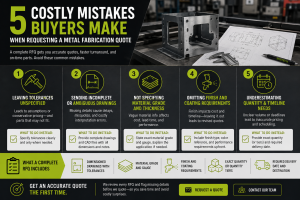
Knowing what happens at each station makes it easier to understand where your specifications actually get used, and where a gap in your RFQ turns into a delay or a quality issue down the line. A tolerance you didn’t specify becomes a guess at the bending station. A finish requirement you left out becomes a follow-up question before the part reaches the coating booth.
It also makes lead time make more sense. Each station takes real time, and a part that touches all eight isn’t a same-day job. Understanding the process is part of understanding why a fabricator quotes the timeline they do. It also gives you a clearer sense of where your own specification can speed things up or slow them down.
See the Process for Yourself
At Wintech, we’re happy to walk buyers through our shop floor, whether that’s a site visit or a detailed look at how your specific part will move through each station. Understanding the process builds trust, and it helps you spec parts that move through production without surprises.
Want to see how your part would be made? Request a Quote or Contact Our Team to learn more about our process.