Category: Engineering & Design Insights

  • How CNC Bending Achieves Tolerances the Human Eye Can’t Measure
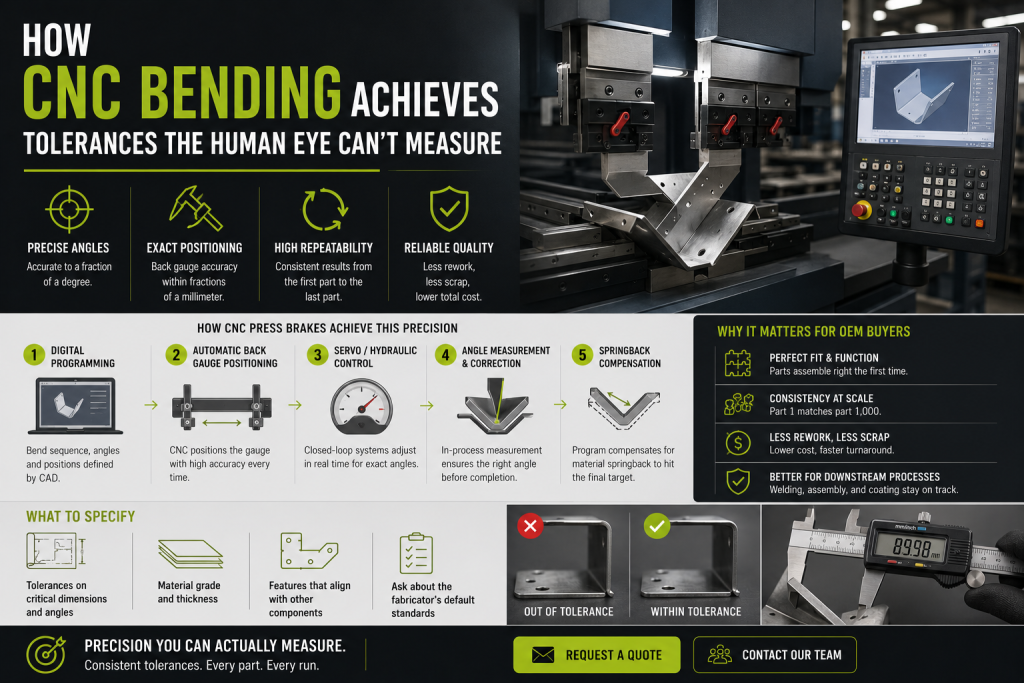
    How CNC Bending Achieves Tolerances the Human Eye Can’t Measure

    Look at two bent brackets side by side and they might appear identical. Measure them with a protractor and a caliper, and one might be off by a degree or two. That small gap is invisible to the eye. But it’s often the difference between a part that assembles cleanly and one that has to be forced into place, filed down, or sent back.

    CNC bending exists to close that gap. Instead of relying on an operator’s judgment to line up a bend by hand, a CNC press brake works from a digital program. That program controls the angle, position, and force of every bend, and it repeats the same result across an entire production run. Here’s how that precision actually works, and why it matters more than most buyers realize.

    What “Precision” Actually Means in Bending

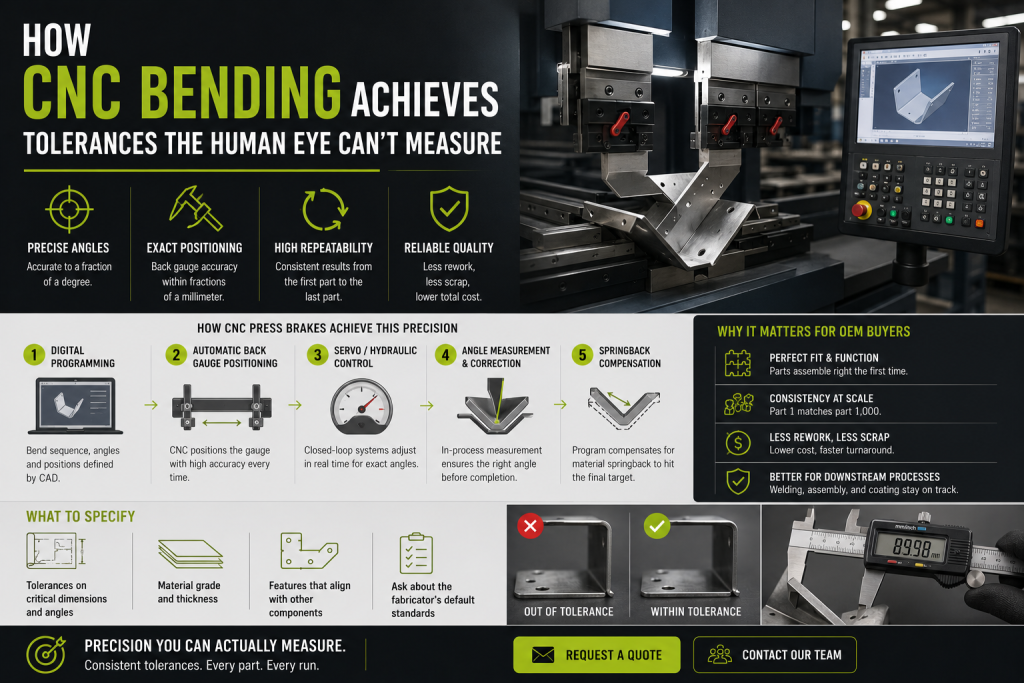
    Precision in CNC bending comes down to three things: bend angle, bend location, and repeatability.

    Bend angle is how far the material folds relative to its original flat plane. A part might call for a 90-degree bend, but even a small deviation, say a degree or two, can throw off how it fits against another component. Human eyesight can typically catch an angle error once it’s several degrees off. A CNC press brake can hold angle accuracy within a fraction of a degree, well below what the naked eye can detect.

    Bend location is where along the part the bend happens. A back gauge controls this. It’s a mechanical stop that positions the material precisely before the press brake closes. Move that gauge by even half a millimeter, and the resulting part dimension shifts by the same amount. CNC systems position the back gauge automatically and consistently. That removes the guesswork of manual measurement and marking.

    Repeatability is what happens when you need part 500 to match part 1. A skilled operator working manually can get close on any single part. But small variations creep in over a long run: fatigue, slightly different hand pressure, a mark that wasn’t quite where the last one was. A CNC program runs the exact same sequence every time. Part 500 comes off the machine the same as part 1.

    How a CNC Press Brake Actually Achieves This

    A few things work together to make this level of precision possible.

    Digital programming. Before any bending starts, the part geometry gets programmed into the machine, either from a CAD file or entered directly. This program defines every bend angle, sequence, and back gauge position for the entire part. It removes manual calculation from the process.

    Servo-electric or hydraulic control systems. Modern CNC press brakes use closed-loop control systems that constantly monitor and adjust the ram position during the bend. If the machine detects the bend isn’t tracking to the programmed angle, it corrects in real time instead of completing an inaccurate stroke.

    Automatic back gauge positioning. The back gauge moves into position automatically between bends, controlled by the same program that sets the bend angle. This eliminates the manual repositioning and re-measuring that introduces error in non-CNC bending.

    Angle measurement and correction. Many CNC brakes include in-process angle measurement systems. These check the actual bend angle mid-stroke and adjust before the press fully closes. This compensates for material variation, since even sheets from the same batch can spring back differently depending on grain direction and internal stress.

    Material springback compensation. Metal doesn’t stay exactly at the angle it’s bent to. It relaxes slightly after the press releases, a behavior called springback. CNC systems account for this by overbending by a calculated amount. That way, the final resting angle matches the spec rather than the angle at the moment of the bend.

    Why This Level of Precision Matters for OEM Buyers

    For a lot of applications, a small tolerance deviation doesn’t matter much. But for OEM parts that need to assemble with other components, mount onto existing equipment, or meet a customer’s own specification, tight tolerances aren’t a nice-to-have.

    Fit and function. A bracket that’s off by even a degree can misalign mounting holes, create gaps in an enclosure, or prevent a panel from sitting flush. In assemblies with multiple fabricated parts, small tolerance errors compound. A part that’s individually within spec can still cause an assembly-level fit problem if several small deviations stack up in the same direction.

    Consistency across a production run. A single well-made prototype doesn’t prove a fabricator can deliver 1,000 identical parts. Repeatability is what makes a production run usable, without checking and adjusting every unit that comes off the line.

    Reduced rework and scrap. Parts that don’t meet tolerance either need rework, which adds labor and time, or get scrapped entirely, which adds material cost on top of that. Tight, consistent bending reduces both.

    Downstream process compatibility. Bent parts that move on to welding, assembly, or powder coating need to hold their dimensions through those later stages too. A part that starts out of tolerance only gets harder to correct as more processes are applied to it.

    What to Specify to Get the Tolerance You Actually Need

    Precision equipment can only deliver precision if the requirement is communicated clearly. A few things worth including in a drawing or RFQ:

    • Call out tolerances on critical dimensions and angles, rather than leaving them blank or assuming a default standard. Not every feature on a part needs the tightest possible tolerance, so specifying which ones matter most helps a fabricator price and process the job appropriately.
    • Note the material grade and thickness, since springback behavior varies by material and affects how a part needs to be programmed to hit its final angle.
    • Flag any features that need to align with another component, such as mounting holes or mating edges, so the fabricator understands where tolerance stacking is most likely to cause a problem.
    • Ask what tolerance standard the fabricator works to by default, and whether tighter tolerances are available if your application needs them. Standards vary by shop, and knowing the baseline helps you decide where a custom spec is actually necessary.

    Precision You Can Actually Measure

    At Wintech, our CNC bending process is built to hold tight, repeatable tolerances across every run, not just the first part off the machine. If your project has fit-critical dimensions or needs to match an existing assembly precisely, our team can walk you through what’s achievable before you commit to a design.

    Have a part with tight tolerance requirements? Contact us with your drawings and specifications, and our team will follow up with any clarifying questions before returning an accurate, detailed quote.

  • What to Include in an RFQ for Custom Metal Fabrication
    What to Include in an RFQ for Custom Metal Fabrication

    A weak RFQ almost guarantees a frustrating quoting process. Vague specs lead to mismatched bids that can’t be compared apples to apples, missing details lead to follow-up emails that stretch a two-week quote turnaround into a month, and unclear expectations lead to a final price that doesn’t match what actually shows up on the shop floor.

    A well-built RFQ does the opposite. It lets suppliers quote quickly and accurately, it lets you compare bids on equal footing, and it sets the tone for a partner relationship built on clear communication from the very first interaction. This guide walks through exactly what to include.

    Why RFQ Quality Determines Quote Quality

    Fabricators quote based on the information in front of them. If your RFQ leaves out a critical detail, one of two things happens: the supplier makes an assumption (which may not match what you actually need), or they come back with questions (which slows down your timeline). Either way, an incomplete RFQ costs you time, and often costs you money if assumptions turn out wrong once production starts.

    The goal of a strong RFQ isn’t just getting a number back quickly. It’s getting an accurate number, one that won’t change once the supplier actually sees the real requirements.

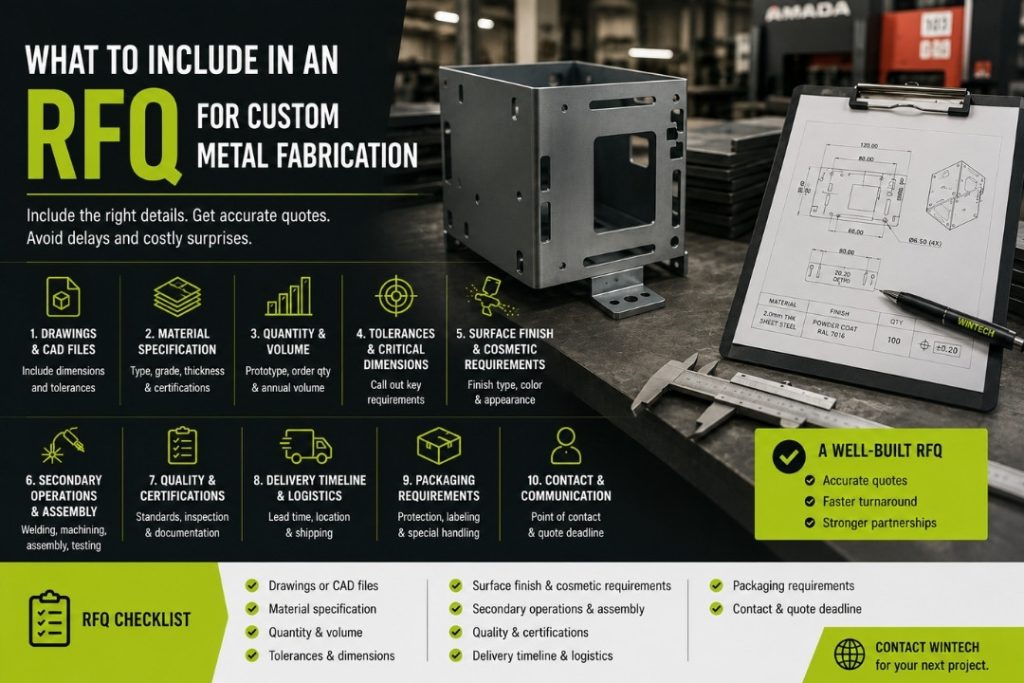
    1. Complete Technical Drawings or CAD Files

    This is the foundation of any RFQ. At minimum, include:

    • 2D drawings with fully dimensioned views, including tolerances
    • 3D CAD models (STEP, IGES, or native format) where available, since these speed up quoting and reduce interpretation errors
    • Clear callouts for critical dimensions, GD&T requirements, and any features that require special attention

    If drawings are still in development, say so. A supplier can often still provide a rough budgetary quote, but flag it clearly as preliminary so there’s no confusion later about why the final quote differs.

    2. Material Specification

    Be specific. “Steel” isn’t enough information to quote accurately. Include:

    • Material type and grade (such as A36 mild steel, 304 stainless, 5052 aluminum)
    • Gauge or thickness
    • Any required material certifications (mill certs, material traceability requirements)
    • Approved substitutions, if any, in case your primary specification has long lead times or supply constraints

    Material cost and availability can swing quotes significantly, so precision here directly affects how comparable your bids will be.

    3. Quantity and Volume Expectations

    Quantity affects pricing more than almost any other RFQ variable, since it determines whether tooling costs, setup time, and batch efficiencies come into play. Include:

    • Prototype or first article quantity, if applicable
    • Initial production order quantity
    • Annual or projected volume, even if it’s an estimate

    If you expect the program to scale over time, say so. Suppliers price differently for a one-time order of 50 units versus an initial order of 50 units that’s expected to grow to 5,000 annually, and knowing your growth trajectory helps them quote tooling and capacity decisions appropriately.

    4. Tolerances and Critical Dimensions

    Beyond what’s already noted on the drawing, call out which tolerances are truly critical to function versus which are standard shop tolerances. This helps suppliers understand where they need to invest in tighter process control (which affects cost) and where standard capability is sufficient.

    Being explicit here also invites useful pushback. A supplier who understands your functional requirements can flag if a tolerance is tighter than necessary, potentially saving you cost without affecting the part’s performance.

    5. Surface Finish and Cosmetic Requirements

    Specify:

    • Required finish type (powder coat, plating, anodizing, mill finish, and so on)
    • Color or finish specification (RAL codes, Pantone references, or physical samples if color matching matters)
    • Cosmetic acceptance criteria, particularly for visible or consumer-facing parts
    • Any masking or selective finishing requirements

    Finishing is often quoted as a separate line item, and unclear finish requirements are one of the most common sources of post-quote clarification requests.

    6. Secondary Operations and Assembly Requirements

    If your parts require more than cutting and forming, spell it out:

    • Welding requirements, including joint type and any applicable welding codes or certifications needed
    • Machining operations beyond the primary fabrication process
    • Assembly instructions, including hardware, fasteners, or sub-component integration
    • Any testing or functional verification required before shipment

    Leaving secondary operations vague is one of the fastest ways to end up with quotes that aren’t actually comparable, since one supplier may have assumed a scope the others didn’t.

    7. Quality and Certification Requirements

    Different industries carry different baseline expectations. Include:

    • Required certifications (ISO 9001, AS9100, IATF 16949, ISO 13485, and so on)
    • Inspection and documentation requirements (dimensional reports, certificates of conformance, material certs, PPAP, first article inspection)
    • Any industry-specific compliance requirements (RoHS, REACH, or similar)

    If your industry doesn’t require formal certifications but you have internal quality expectations, state them anyway. A supplier’s quote should reflect the actual quality process your program requires, not a generic baseline.

    8. Delivery Timeline and Logistics

    Include:

    • Required lead time for prototypes or first articles
    • Required lead time for production quantities
    • Delivery location and any special packaging or shipping requirements
    • Whether you need staggered deliveries, blanket orders, or just-in-time delivery scheduling

    If your timeline is firm (tied to a product launch or a customer commitment, for example), say so directly. Suppliers can often accommodate tight timelines with the right advance notice, but only if they know about the constraint upfront.

    9. Packaging Requirements

    Packaging is easy to overlook but can meaningfully affect both cost and part condition on arrival. Note any requirements around:

    • Protective packaging for cosmetic or precision parts
    • Palletization or crating standards
    • Labeling requirements
    • Any customer-specific packaging specifications you need to pass through

    10. Point of Contact and Communication Expectations

    Include who suppliers should direct questions to, and by when you need the quote returned. If you’re running a formal bid process with a set deadline, state it clearly, along with how you’d like questions handled (a single point of contact, a Q&A document, and so on) to keep the process fair and efficient across all bidders.

    RFQ Checklist Summary

    Before sending your RFQ, confirm it includes:

    • Complete drawings or CAD files, with clear tolerance callouts
    • Full material specification, including grade and certification requirements
    • Quantity for prototypes, initial orders, and projected annual volume
    • Critical tolerances flagged separately from standard tolerances
    • Finish and cosmetic requirements, including color specification
    • All secondary operations: welding, machining, assembly, testing
    • Required quality certifications and documentation
    • Delivery timeline and location
    • Packaging requirements
    • Point of contact and quote deadline

    A Better RFQ Leads to a Better Partner Relationship

    A thorough RFQ does more than get you a fast, accurate quote. It signals to potential suppliers that you run a well-organized program, which tends to attract more serious, detailed responses in return. It also gives you a much stronger basis for comparing bids, since suppliers quoting against identical, complete information are far easier to evaluate side by side than suppliers each filling in their own assumptions.

    If you’re not sure whether your RFQ has everything a supplier needs, a good fabrication partner will tell you what’s missing rather than just quoting around the gaps. That responsiveness, even before you’ve placed an order, is often a useful early signal of how the relationship will work once you do.

    Have a project ready to quote? Contact us with your drawings and specifications, and our team will follow up with any clarifying questions before returning an accurate, detailed quote.