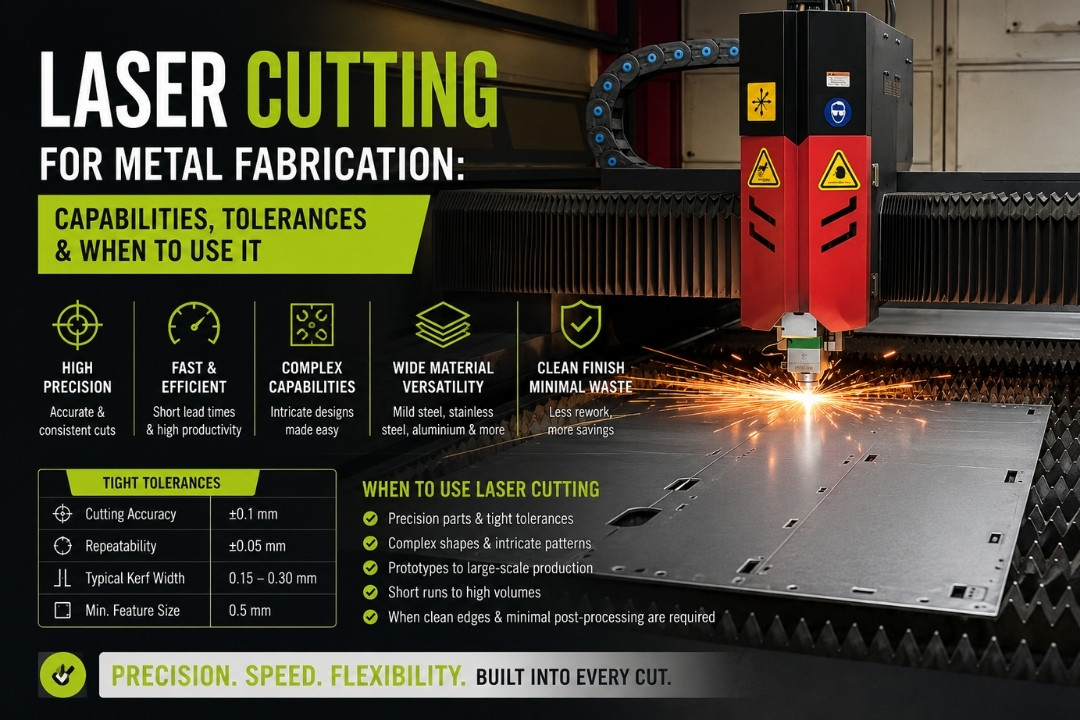
Laser cutting has become the default choice for sheet metal fabrication and for good reason. It’s fast, precise, and capable of cutting complex geometries that would be impractical with mechanical methods. But “we use laser cutting” doesn’t tell you much about whether a supplier can hit your tolerances, handle your material thickness, or deliver the edge quality your application needs.
This guide covers how laser cutting actually works, what determines quality and tolerance, and when it’s the right process choice versus alternatives like plasma or waterjet cutting.
How Laser Cutting Works
A fabrication laser directs a high-powered, focused beam through a nozzle onto the metal surface. The beam melts or vaporizes the material along the programmed path, while an assist gas, typically oxygen, nitrogen, or compressed air, blows the molten material out of the kerf (the cut width).
Modern fabrication shops predominantly use fiber lasers rather than older CO2 laser technology. Fiber lasers deliver higher energy efficiency, faster cutting speeds on thin-to-medium gauge material, and lower operating costs, which is why they’ve largely become the industry standard for sheet metal work.
Materials and Thickness Ranges
Laser cutting handles a wide range of metals, though capability varies by laser power and material type:
| Material | Typical Thickness Range |
| Mild steel | Up to ~1 inch (with high-power lasers) |
| Stainless steel | Up to ~0.75 inch |
| Aluminum | Up to ~0.5 inch |
| Galvanized steel | Up to ~0.25 inch |
Thicker material is cuttable, but cutting speed drops and edge quality can degrade, which affects both cost and secondary finishing needs. For very thick plate, plasma or waterjet cutting sometimes becomes more cost-effective than pushing a laser to its upper limit.
Achievable Tolerances
Laser cutting is prized for tight, repeatable tolerances, but the achievable tolerance depends on material thickness, part geometry, and machine calibration. As general guidance:
- Thin gauge material (under 0.125 in): tolerances around ±0.003–0.005 in are commonly achievable
- Medium gauge (0.125–0.25 in): typically ±0.005–0.010 in
- Thicker material (above 0.25 in): tolerances widen further, often ±0.010–0.020 in
These are general ranges, not guarantees, always confirm a specific supplier’s tolerance capability for your exact material and thickness combination, and request sample dimensional reports if tolerance is critical to your application.
Edge Quality and Assist Gas Selection
The assist gas used during cutting significantly affects edge quality, speed, and downstream processing:
- Oxygen assist reacts exothermically with the metal, allowing faster cutting of thicker mild steel, but leaves an oxidized edge that may need additional finishing before painting or welding.
- Nitrogen assist produces a clean, oxide-free edge ideal for stainless steel and aluminum, especially when the part will be welded or requires a cosmetic finish. Slower and more gas-intensive than oxygen cutting.
- Compressed air, a lower-cost option for thinner, less critical parts where edge oxidation isn’t a concern.
If your parts will be welded, plated, or left with a visible edge, ask your fabricator which gas they’ll use and why — it directly affects both appearance and downstream processing cost.
When Laser Cutting Is the Right Choice
Laser cutting is generally the best fit when:
- You need tight tolerances on flat or near-flat sheet metal parts
- Your geometry includes intricate cutouts, small holes, or fine detail
- You’re running small-to-medium batch sizes where tooling costs (like stamping dies) aren’t justified
- Material thickness falls within the sweet spot of ¼ inch or under, where laser cutting is both fast and highly precise
When to Consider Alternatives
Laser cutting isn’t always the optimal process:
- Very thick plate (over ~1 inch): Plasma or waterjet cutting is often faster and more cost-effective.
- Reflective materials like copper or brass at high thickness: These can be challenging for certain laser configurations and may cut more reliably with waterjet.
- Heat-sensitive applications: Waterjet cutting introduces no heat-affected zone, which matters for materials prone to warping or metallurgical changes from heat input.
- Extremely high-volume, identical parts: Stamping may ultimately be more economical once tooling costs are amortized across large production runs.
A good fabrication partner will tell you when a different process serves your part better — even if it means a smaller laser cutting order for them.
Design Considerations That Affect Laser-Cut Part Cost and Quality
A few design choices have an outsized effect on both cutting cost and final part quality:
- Minimum feature size: Small holes or slots relative to material thickness can distort during cutting. A general rule of thumb is that hole diameter shouldn’t be smaller than the material thickness.
- Nesting efficiency: Part geometry affects how efficiently parts nest on a sheet, directly impacting material utilization and cost.
- Kerf width: The laser removes a small amount of material along the cut path. For tight-fitting mating parts, this needs to be accounted for in the design.
- Heat-affected zone (HAZ): Even with laser cutting’s relatively narrow HAZ, tightly spaced cuts can cause localized heat buildup and part distortion.
Involving your fabrication partner during the design phase, rather than after drawings are finalized, often catches these issues before they become costly rework.
Laser Cutting as Part of a Larger Fabrication Process
For most OEM parts, laser cutting is just the first step. Cut blanks typically move on to forming, welding, and finishing operations. A fabricator who handles the full process in-house, rather than outsourcing cutting to a separate shop, can maintain tighter dimensional control across the entire part lifecycle, since the same team managing tolerances at the cutting stage also owns the downstream operations.
Looking for a metal fabrication partner who treats your program like their own? Contact us to discuss your part requirements and see how our engineering and quality teams support OEM programs from prototype through full production.